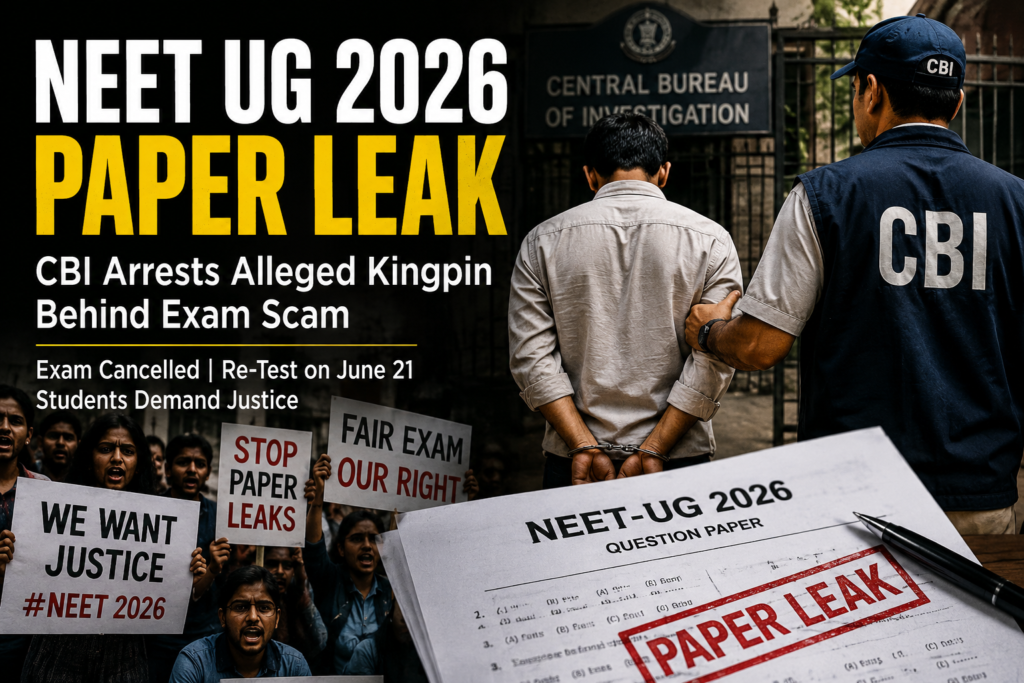
What was supposed to be a life-changing opportunity for lakhs of aspiring doctors has now turned into one of the biggest education scandals in recent years. The alleged NEET-UG 2026 paper leak has shaken the confidence of students, parents, and teachers across the country, raising serious concerns about the fairness and credibility of India’s competitive examination system.
For months, students sacrificed sleep, comfort, and peace of mind to prepare for one of the toughest exams in the country. But just days after the examination, reports of leaked papers, irregularities, and organised malpractice began surfacing, leaving thousands of honest aspirants feeling betrayed and helpless.
With the Central Bureau of Investigation (CBI) stepping into the case and multiple arrests already made, the controversy has now grown far beyond an examination issue. It has become a national debate about corruption, accountability, and the future of deserving students whose dreams depend on a fair and transparent system.
CBI Arrests Alleged Mastermind, But Questions Still Remain
In a major breakthrough, the CBI arrested Pune-based chemistry lecturer P.V. Kulkarni, who has been described by investigators as the alleged “kingpin” behind the NEET-UG 2026 paper leak. According to reports, Kulkarni was linked to the examination process through the National Testing Agency (NTA), allegedly giving him access to highly confidential question papers.
Investigators claim that he conducted secret coaching sessions for selected students at his Pune residence during the last week of April, where questions, answer options, and correct responses were allegedly shared in advance. Shockingly, these details reportedly matched the actual NEET-UG 2026 paper conducted on May 3.
The CBI has also arrested several accused from Maharashtra, Rajasthan, and Haryana for allegedly acting as middlemen, arranging payments, and circulating leaked material through encrypted messaging apps.
However, the arrests have also triggered public anger and frustration. Many students and parents are now asking a serious question: If last year’s controversy led to investigations, promises of stricter security, and nationwide outrage, then how did another major leak happen again this year?
Critics argue that arresting a few individuals after every scandal is not enough when the system itself continues to fail honest aspirants repeatedly. Each year, students spend months under immense pressure preparing for these examinations, only to watch their hard work get overshadowed by allegations of corruption and organised cheating networks.
For many aspirants, the issue is no longer just about one accused mastermind. It is about a deeper failure of accountability, where paper leaks keep returning despite investigations, reforms, and assurances from authorities.
Students Lose Trust in the System
More than 22 lakh students appeared for NEET-UG 2026 after months and years of intense preparation, hoping to earn a medical seat through hard work and fair competition. But the paper leak controversy has left thousands of aspirants frustrated, mentally exhausted, and deeply disappointed.
With the exam now cancelled and a re-test scheduled for June 21, students are once again being forced into stress, uncertainty, and emotional pressure. Across the country, protests have erupted as students and education activists demand transparency, accountability, and a system that truly protects honest aspirants.
Questions on NTA’s Examination Security
The NEET-UG 2026 controversy has once again put the National Testing Agency under intense public scrutiny. In recent years, repeated allegations of paper leaks, security lapses, and examination mismanagement in major entrance tests have steadily weakened students’ confidence in the system.
Education experts say the latest incident exposes serious flaws in the protection of confidential examination material. Critics argue that if insiders can allegedly gain access to question papers before the exam, then India’s testing system urgently needs stronger digital security, stricter monitoring, and greater accountability.
Amid growing outrage, Union Education Minister Dharmendra Pradhan has announced that NEET will shift to a fully computer-based format from next year in an effort to reduce the risk of future paper leaks.
NEET Leak Is More Than an Exam Scandal
NEET is not just an entrance examination. For millions of students across India, it represents years of sacrifice, discipline, and the dream of becoming a doctor. When the fairness of such an exam is compromised, it shakes public faith in the entire education system.
The biggest danger is not only the leak itself, but the growing belief among students that honesty and hard work may no longer be enough to succeed. That is why the NEET paper leak is not just a legal controversy. It is a serious social and moral crisis affecting the future of India’s youth.
India’s Education System Needs Urgent Reform
The NEET-UG 2026 controversy must become a turning point, not just another headline that fades with time. Arresting the accused is necessary, but real change will only come through strong and long-term reforms.
Experts and students are demanding stricter cybersecurity, transparent examination systems, faster investigations, and independent monitoring to prevent such incidents from happening again. India’s youth deserve a system where success is earned through talent and hard work, not destroyed by corruption and paper leaks.
About the Author