As West Bengal moves toward the 2026 Assembly elections, there’s a strange tension in the air. The state is set to vote in phases, but the real buzz isn’t about jobs, development, or governance. It’s about voter identity, electoral rolls, and who actually makes it to the list.
That shift isn’t just noticeable, it’s worrying. It raises a sharp question: are elections still about what leaders have delivered, or are they slowly turning into contests over who gets counted as a voter in the first place?
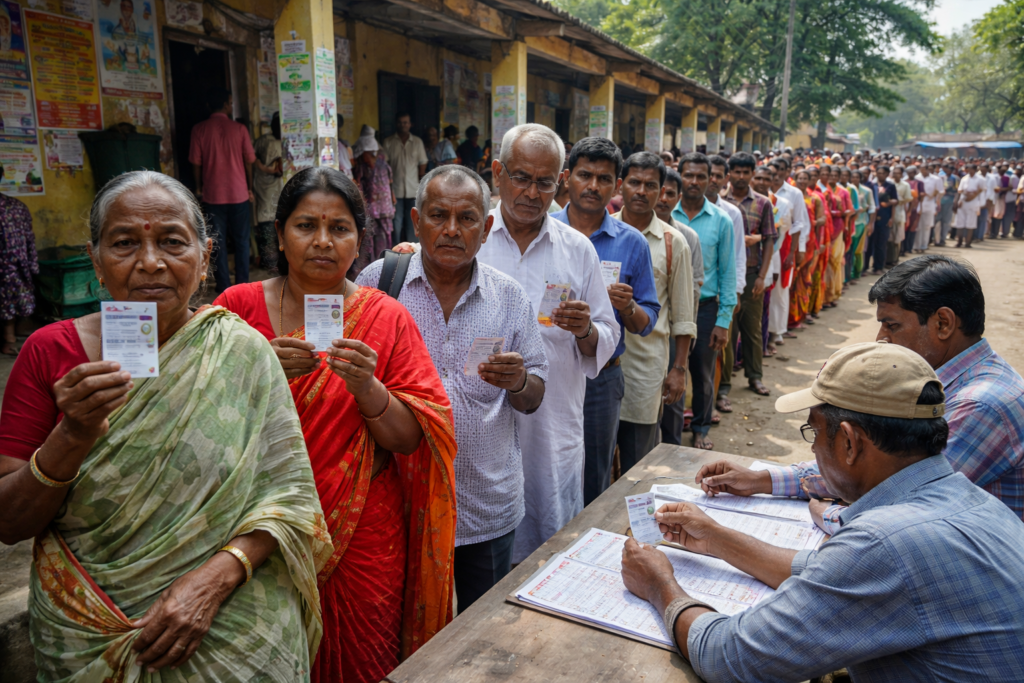
From Governance to Identity Politics: A Noticeable Shift
For over a decade, West Bengal has been under the leadership of Mamata Banerjee and her party, the Trinamool Congress. By all accounts, this election should have been a moment of accountability — a report card on jobs, industrial growth, and how well the government has handled everyday challenges.
But that’s not the story unfolding on the ground.
Instead, the political conversation has drifted toward identity, religion, and questions over voter eligibility. The core issues of governance have quietly slipped into the background. It reflects a larger trend, where elections are no longer fought on performance alone, but on narratives that shape who belongs and who gets to decide the outcome.
The Voter Roll Storm: When Numbers Decide Narratives
At the heart of this election is a controversy that refuses to settle — the Special Intensive Revision (SIR) carried out by the Election Commission of India.
The numbers alone tell a powerful story. Nearly 91 lakh voters — around 12% of the electorate — were initially removed during the revision. On top of that, over 60 lakh names were flagged for so-called “logical discrepancies,” leaving millions uncertain about their right to vote.
The situation escalated to the Supreme Court of India, which stepped in to review the process. After scrutiny, about 27 lakh names were ultimately struck off, with an option to appeal before tribunals. But here’s the real concern — there’s still no clear answer on whether these appeals will be resolved before polling begins.
For many citizens, this goes far beyond a routine administrative exercise. It feels personal. It feels like the very right to participate in democracy is being put on hold.
When Data Raises Questions: A Pattern Too Stark to Ignore
The debate doesn’t end with numbers — it deepens when those numbers are closely examined. Research by the SABAR Institute has added a new layer of concern.
Their analysis of the Nandigram constituency points to a pattern that’s hard to overlook. Out of nearly 2,900 voter deletions studied, more than 2,700 belonged to one community — Muslims. That’s over 95%.
These findings are now at the center of a growing debate. While interpretations may differ, the data has clearly intensified concerns around fairness, transparency, and whether the revision process has been carried out without bias.
Behind the Numbers: The Quiet Battle to Decode Voter Data
What makes this story even more layered is how hard it actually is to access and analyse voter data in the first place.
Electoral rolls aren’t released as clean, usable datasets. They come as scattered PDF files, often messy and difficult to navigate. To extract any meaningful insight, researchers have had to sift through thousands of pages, relying on tools like OCR and machine learning just to piece the data together.
And even then, it’s far from perfect. Errors creep in. Classifications get tricky. Verification takes time. Yet despite all these hurdles, independent researchers continue to push through — trying to bring some clarity to a system that, for many, still feels opaque and hard to trust.
The Politics of Perception: Narratives Over Numbers
Different political forces are shaping this issue in their own way. The Trinamool Congress has called the voter deletions a calculated move by the Centre, while the Bharatiya Janata Party has leaned into arguments around illegal voters and identity.
Caught in the middle of this political tug-of-war are ordinary citizens — many of them left with a basic but unsettling doubt: will they even get the chance to vote?
What Should Really Matter: The Missing Conversation
At its core, West Bengal needs a grounded, honest conversation about jobs, industrial growth, and economic progress. It’s a state known for its deep cultural and intellectual legacy, yet it continues to struggle on key development fronts.
Elections are meant to address these gaps. They’re supposed to offer solutions. But when the focus shifts to identity and eligibility, the real issues quietly fade into the background.
A Test of Democracy Itself
Democracy stands on a simple idea — every eligible citizen deserves a voice. The moment that idea is questioned, the foundation begins to shake.
The 2026 West Bengal elections are about more than just forming a government. They’re a test of the system itself — of whether the process remains fair, inclusive, and transparent, or slowly drifts into something else.
About the Author