When people hear the word philosophy, they often think of complicated theories and long debates. But honestly, it’s much simpler than that. Philosophy is just the love of wisdom — a way of trying to understand life a little better.
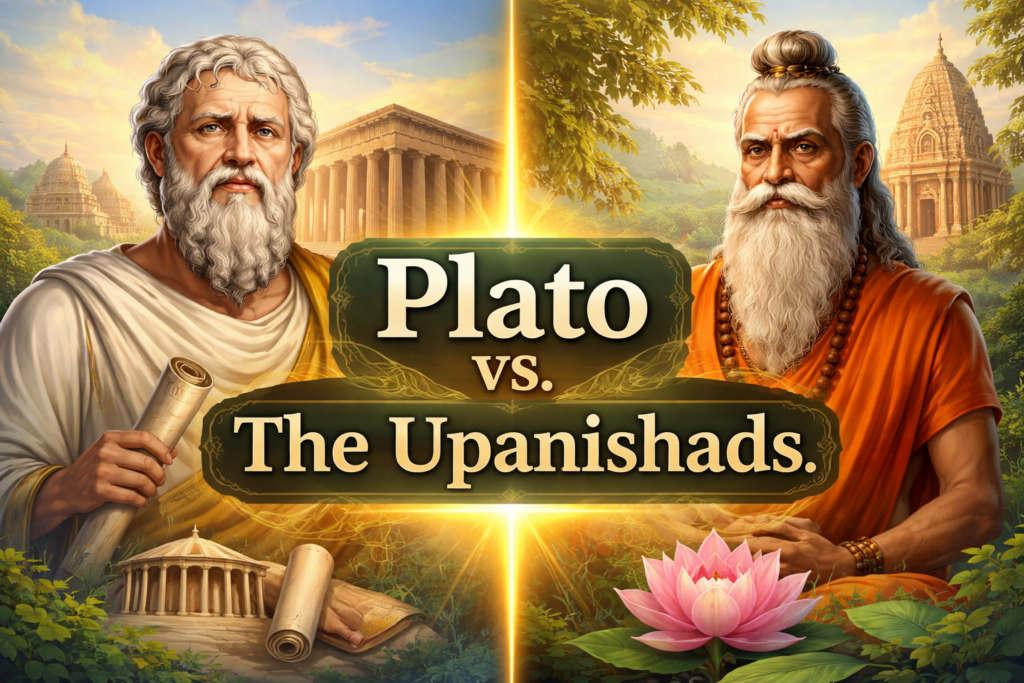
That’s exactly what both Plato’s Dialogues and the Upanishads are doing. Even though they come from two very different worlds — ancient Greece and ancient India — they’re asking the same big questions. Who are we? What is the truth? What is the meaning of life?
What’s really interesting is this: despite the distance in culture and time, their ideas often feel surprisingly similar. It’s like two different paths leading toward the same search for truth.
The Common Ground: Knowing Yourself
One place where Plato and the Upanishads really connect is this idea of knowing yourself.
Socrates, who deeply influenced Plato, believed that real wisdom begins when you start questioning your own life. He didn’t just give answers. He kept asking questions, pushing people to look within and understand who they really are.
The Upanishads take this idea even further. They say that your true self, called Atman, isn’t separate from the universe. It’s actually one with Brahman, the ultimate reality. In simple words, when you truly understand yourself, you’re also understanding the whole universe.
So, even though they come from different cultures, both paths point in the same direction. Real knowledge isn’t just about collecting information or memorizing facts. It’s about change. It’s about becoming aware, growing, and discovering your true self.
The Problem of Desire
Another place where both ideas come together is how they look at desire.
Plato saw desire as something that can pull us away from truth. He used a simple image to explain it — the soul is like a chariot. Reason is the driver, while emotions and desires are like wild horses. If the horses aren’t controlled, the chariot goes off track. But if reason guides them, the journey stays on the right path.
The Upanishads share a similar view. They say that uncontrolled desire keeps us stuck in confusion and suffering. It makes us chase things that don’t truly satisfy us.
But they also add an important point — not every desire is bad. The desire to learn, to grow, and to find truth can actually help us move forward and become free.
So, both don’t tell you to kill desire completely. Instead, they say: understand it, control it, and guide it in the right direction.
Education as Inner Growth
For Plato, education wasn’t about filling your mind with facts. He believed the truth is already inside you — learning is just the process of bringing it out. In a way, he saw learning as remembering something your soul already knows.
The Upanishads look at education in a very similar way. They talk about two kinds of knowledge. One is lower knowledge — things like skills, books, and worldly learning. The other is higher knowledge — understanding your true self. And according to them, that’s the real goal of education: realizing “I am Brahman,” meaning you are one with the ultimate reality.
So in both traditions, education isn’t just about marks, degrees, or information. It’s something deeper. It’s about inner growth, self-realization, and truly understanding who you are.
Where They Differ
Even with all these similarities, there’s one big difference that really sets them apart.
Plato believed that the soul is created by a divine power. After death, it returns to a higher realm — something pure and beyond this world. But even then, the soul remains separate from that ultimate source.
The Upanishads take a very different view. They say the soul isn’t separate at all. It’s already one with the ultimate reality. There’s no real journey back, no distance to cover. It’s just about realizing a truth that has always been there.
And this small difference changes the whole picture.
For Plato, the goal is to rise upward, to reach something higher.
For the Upanishads, the goal is to wake up and realize you were already there.
Final Thoughts
Even though Plato and the Upanishads come from completely different worlds, they meet at one powerful idea: life isn’t just about surviving or chasing success. It’s about understanding who we really are.
Both ask us to slow down, look beyond everyday distractions, and question what we usually take for granted. They push us to turn inward and search for something deeper.
You can follow Plato’s path of reasoning and questioning, or the Upanishadic path of inner realization. The approach may differ, but the destination feels the same — discovering the truth within yourself.
And maybe, in the end, that’s what philosophy was always meant to be.
About the Author