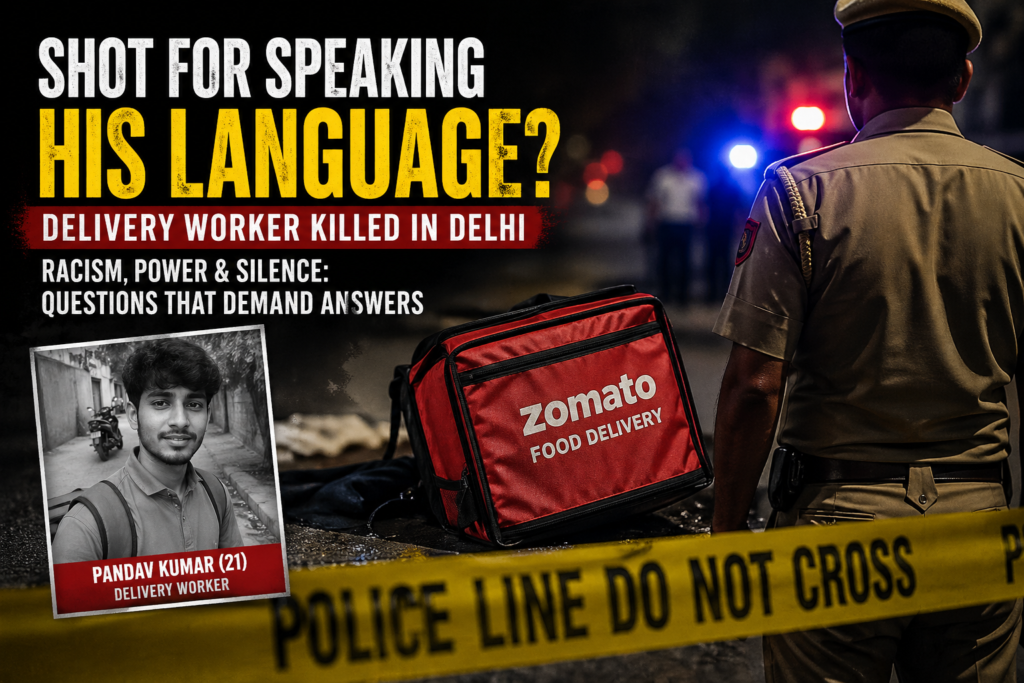
What should have been just another quiet night turned into a chilling tragedy. Pandav Kumar, a 21-year-old delivery worker, stepped out after a small birthday gathering in Delhi’s Jaffarpur Kalan, standing by the roadside with a friend, talking like anyone would after a late-night get-together.
There was no crime. No chaos. No reason for fear. Just two young men sharing an ordinary moment in the stillness of the night.
And then, in a matter of seconds, everything changed.
A single gunshot shattered the silence—and a life was lost far too soon.
The Incident
According to eyewitness accounts, a man later identified as a Delhi Police head constable approached the group. An argument followed. What triggered it is still under investigation, but those present claim the situation escalated quickly.
Pandav and his friend Krishna were sitting on a motorcycle when the accused allegedly fired at them from very close range. The bullet pierced through Pandav’s chest and then struck Krishna in the abdomen.
Pandav died on the spot. Krishna survived but was rushed to the hospital and remains under treatment.
Allegations That Go Beyond Violence
What has made this case even more disturbing are the serious allegations made by the victim’s family and witnesses.
They claim that the accused got angry after hearing the two men speak in their native language. They also allege that remarks targeting their identity as migrants from Bihar were made before the shooting.
This raises an uncomfortable question: can someone be targeted just for who they are or how they speak?
Right now, these claims are part of the ongoing investigation. But even the possibility of such a motive has triggered outrage and concern.
Power, Uniform, and a Fatal Question
The accused isn’t just another citizen. He’s a serving police officer—someone meant to protect, not provoke fear.
That changes the stakes completely.
When a man in uniform allegedly fires his service weapon in a moment of anger, it’s not just a lapse in judgment—it’s a crack in the system itself. It raises urgent questions about discipline, accountability, and how power is handled behind the badge.
The case has sparked demands for strict action, full transparency, and an investigation that leaves no room for doubt. The officer has reportedly been taken into custody, but the bigger question still hangs—will the system hold its own accountable?
When Silence Speaks Louder Than Outrage
What’s unsettling isn’t just the incident—it’s the quiet around it. The lack of widespread attention has raised eyebrows, with many questioning whether the response would’ve been very different if the victim came from another background or region.
Right or wrong, that perception fuels frustration. It points to a deeper, uncomfortable reality—some stories echo across the country, while others barely make a sound. And in that silence, people are left wondering whose voices truly matter, and whose are too easily ignored.
More Than a Headline: The Life Behind the Loss
Amid all the outrage and arguments, it’s easy to forget what’s really gone.
Pandav Kumar wasn’t just a name in a report. He was a 21-year-old trying to earn, to support his family, to build something for himself. Reports say he was the sole breadwinner—the one his family depended on.
His death isn’t just a number added to a list. It’s a life abruptly cut short, a home left struggling, and a future that ended before it even had a chance to begin.
Beyond the Bullet: The Question We Can’t Ignore
At its core, this incident pushes us to face a deeply uncomfortable truth.
Are we slowly becoming intolerant of differences that should never matter—language, background, identity? Are these everyday markers of who we are turning into reasons for division, or worse, violence?
And the bigger concern still lingers—can people truly feel safe if such differences become triggers for harm? If something as basic as where you come from or how you speak can put you at risk, then the issue goes far beyond a single incident. It becomes a question about the kind of society we’re building.
Beyond the Verdict: What This Case Leaves Behind
The investigation will uncover facts and fix legal responsibility. But this case has already moved beyond the courtroom.
It has sparked a larger, more unsettling conversation.
No one should have to fear for their life because of how they speak, where they come from, or who they are. Yet when such fears begin to feel real, it signals something deeper than a failure of law and order.
It becomes a question of who we are as a society—and what we are slowly becoming.
About the Author