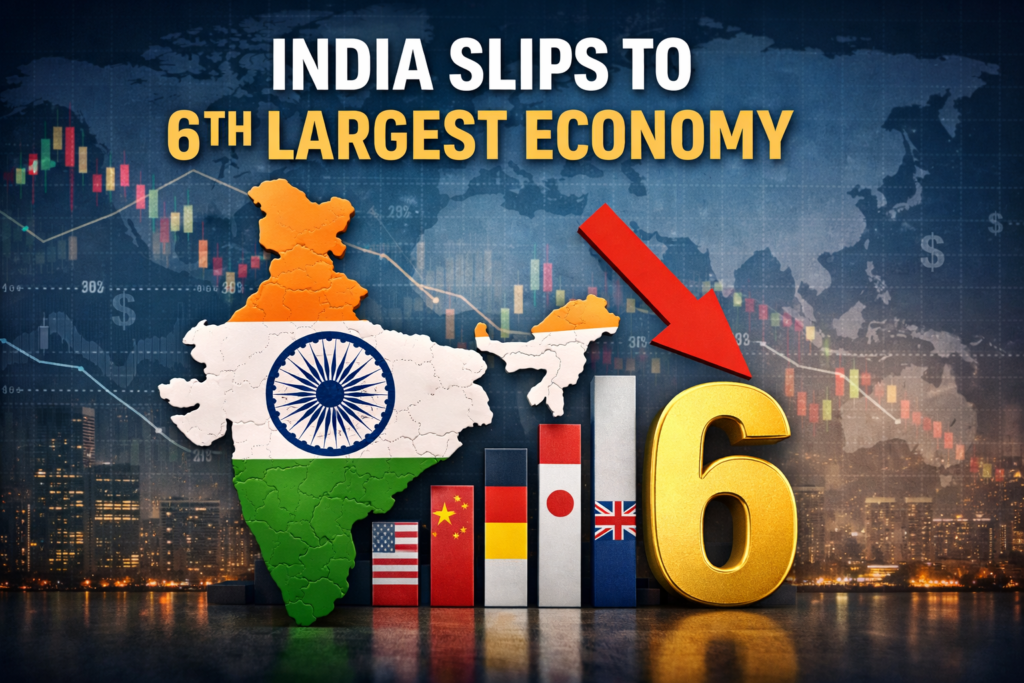
India has slipped to sixth place among the world’s largest economies, according to fresh data from the International Monetary Fund. Just a year ago, there was buzz about India overtaking others to become the fourth-largest economy. So the drop has caught attention. But here’s the twist—it doesn’t mean the economy is weakening. In fact, the real story is far more complex than a simple change in rankings.
Ranking Slip or Reality Twist? Here’s What’s Really Going On
At first glance, dropping a spot in global rankings sounds like bad news. But that’s not the full picture. India is still one of the fastest-growing major economies, with strong domestic momentum and steady expansion.
So why the dip? It mostly comes down to how rankings are measured. Global comparisons rely on GDP in US dollars. That means even if India’s economy grows solidly in rupees, currency movements can shift its position on paper—without reflecting any real slowdown on the ground.
What Really Pulled India Down the Rankings? The Hidden Factors Explained
1. Rupee Takes a Hit, Rankings Feel It
A big reason behind the dip is the weakening of the Indian rupee against the US dollar. Since global rankings are based on GDP in dollar terms, a softer rupee can make the economy look smaller on paper—even when it’s actually growing at home.
2. GDP Reset Changed the Numbers
India also revised the base year for calculating GDP. This is a normal update to reflect current economic realities. But in the short term, it can tweak the numbers and slightly lower the nominal GDP when seen globally.
3. Optics vs Reality: A Technical Dip
Put together, these factors created the illusion of a slowdown. But nothing fundamental has changed. The economy hasn’t shrunk—it just appears smaller due to technical adjustments, not because growth has weakened.
Still a Global Powerhouse: Where India Truly Stands
India now ranks just behind the United States, China, Germany, Japan, and the United Kingdom—firmly holding its place among the world’s economic giants. With a GDP hovering close to the $4 trillion mark, it’s still very much in the top league.
What really stands out is growth. While many major economies are slowing down, India continues to surge ahead, with projected growth of around 6–7% in the coming years—making it one of the fastest-growing big economies in the world.
India’s Growth Engine Is Still Firing Strong
The ranking may have shifted, but India’s economic story is far from slowing down. Strong consumer demand, rapid infrastructure push, and a booming services sector continue to power growth. Between 2021 and 2025, India remained one of the fastest-growing major economies in the world.
Most experts see this dip as short-lived. Projections suggest India could climb back to the fourth spot by 2027—and if momentum holds, it may even break into the top three economies by the early 2030s.
Storm Clouds Ahead? Key Risks to Keep an Eye On
That said, it’s not all smooth sailing. Rising global tensions, especially in regions like West Asia, could drive up oil prices. For a country like India, which relies heavily on energy imports, that can quickly translate into higher inflation and added pressure on growth.
Costlier fuel, a rising import bill, and tighter government spending could weigh on the economy in the short term. In fact, some global agencies have already trimmed their growth forecasts slightly, factoring in these risks.
Beyond Rankings: The Bigger Picture You Shouldn’t Miss
What this situation really highlights is the gap between perception and reality. Global rankings are influenced by exchange rates and technical revisions, which can shift positions without truly reflecting economic strength on the ground.
India’s slip in ranking doesn’t change its core story. The growth momentum is still intact, and the broader trajectory remains upward. If current trends continue, this dip could turn out to be just a brief pause in a much larger growth journey.
Final Take: Numbers Changed, Story Didn’t
India moving to sixth place is more about how numbers are calculated than any real economic setback. The economy is still expanding, and its fundamentals remain strong.
Instead of getting caught up in rankings, the real focus should be on long-term growth—and on that front, India continues to stand out as one of the most promising economies in the world.
About the Author