Bihar wasn’t always struggling the way it is today. There was a time when it stood at the center of knowledge, culture, and progress in India. But somewhere along the way, things changed. Today, when people ask why Bihar is backward, the answer isn’t simple. It’s a mix of missed opportunities, weak governance, lack of development, and everyday struggles faced by its people. This blog takes a clear and honest look at how a state with so much potential ended up fighting to keep up, and what life really looks like for those living there now.
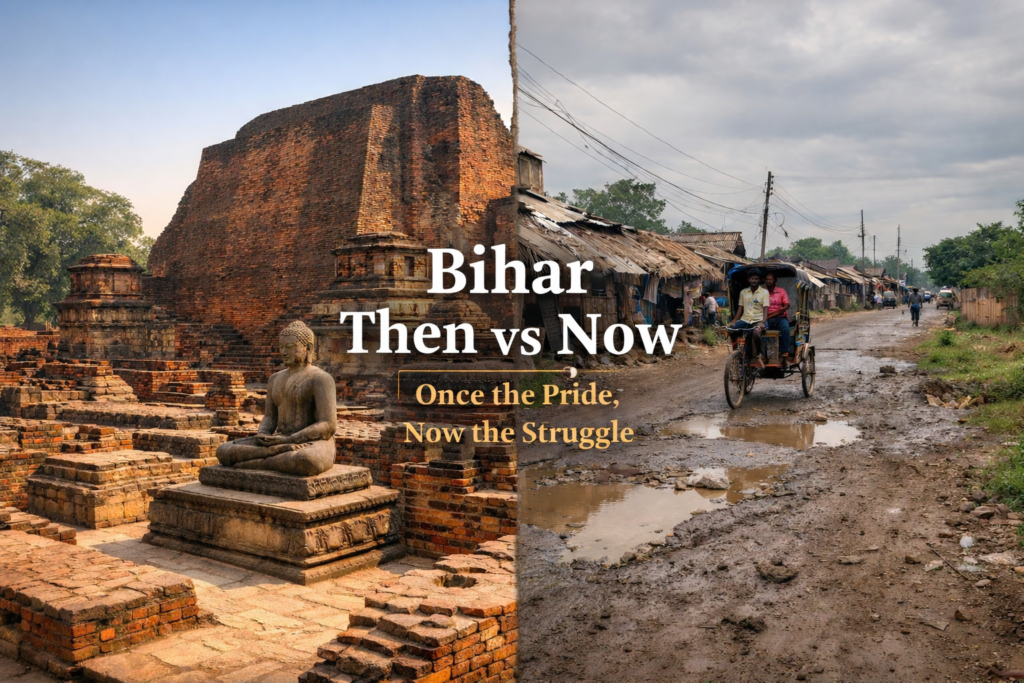
From Pride to Problems – Where Did Bihar Lose Its Way?
There was a time when Bihar was leading from the front. It was a place of learning, power, and strong cultural roots. Great centres of education, effective leadership, and active trade made it one of the most important regions in India. People looked up to Bihar for ideas and direction.
Now, the image has changed. Bihar is often seen as struggling and falling behind. So the real question isn’t just what Bihar was — it’s how a state with so much strength and history ended up in this situation.
Not Just History – Bihar Once Truly Led the Way
Bihar’s past greatness isn’t just something people talk about for pride—it actually existed. From ancient times to the freedom movement, the state produced strong leaders like Dr. Rajendra Prasad, Jayaprakash Narayan, and Jagjivan Ram. Cities like Patna were once seen as important centres of growth and influence. Bihar was ahead in education, social change, and governance.
That’s why its fall isn’t something that just happened on its own—it slowly unfolded over time, shaped by a mix of serious issues and missed chances.
When It Started Going Wrong – The Colonial Impact
Bihar’s problems didn’t begin recently. A big turning point came during British rule.
The Permanent Settlement of 1793 changed how land and taxes worked. Taxes were fixed, no matter how much farmers produced. This killed the motivation to improve farming. Slowly, agriculture weakened, and money that could have gone into education or healthcare never came.
While some other regions adapted and grew, Bihar was left stuck in a system that held it back.
A Chance Lost After Independence
When India became independent in 1947, Bihar had a real shot at growth. But things didn’t go as planned.
Policies like the Freight Equalisation Policy removed Bihar’s natural advantage in raw materials. Industries could now set up anywhere, so many chose other states with better infrastructure. Bihar, despite having resources, missed out on industrial growth.
Then came the creation of Jharkhand in 2000. Bihar lost most of its mineral-rich areas, which further weakened its economy.
Years That Slowed Everything Down
The period between 1990 and 2005 is often seen as a time when Bihar lost momentum.
Governance issues, rising crime, and poor infrastructure made things worse. Investors stayed away. Jobs became scarce. Growth almost came to a standstill.
At the same time, politics shifted heavily towards caste-based focus. Social justice mattered, no doubt—but development took a back seat, and the overall progress of the state suffered.
Nature and Geography Didn’t Help Either
Bihar also faces some tough natural and structural challenges.
Floods hit the northern parts almost every year, while drought affects the south. A large population puts constant pressure on limited resources. Being landlocked makes transport and trade more expensive. On top of that, weak infrastructure slows down any serious development.
All of this makes progress much harder than it should be.
What Bihar Looks Like Today
The situation today reflects years of these combined problems.
Many people still deal with poverty, unemployment, and lack of basic services. Schools and hospitals are improving, but not fast enough. Because of this, lakhs of people leave Bihar every year to find work and a better life elsewhere.
Even then, one thing hasn’t faded—Bihar’s cultural strength. Its traditions, festivals, and strong social values still hold people together.
Not the End of the Story
Bihar’s condition today isn’t because of one single mistake. It’s the result of years of neglect, policy failures, unstable governance, and natural challenges.
But this isn’t the end. Bihar still has what it takes—its people, its culture, and its history of leadership. With the right focus on education, industries, and better governance, things can change.
Bihar has risen before. There’s no reason it can’t rise again.
About the Author