“Old Law, New Questions: Supreme Court Reconsiders ‘Industry’ Definition After Decades”
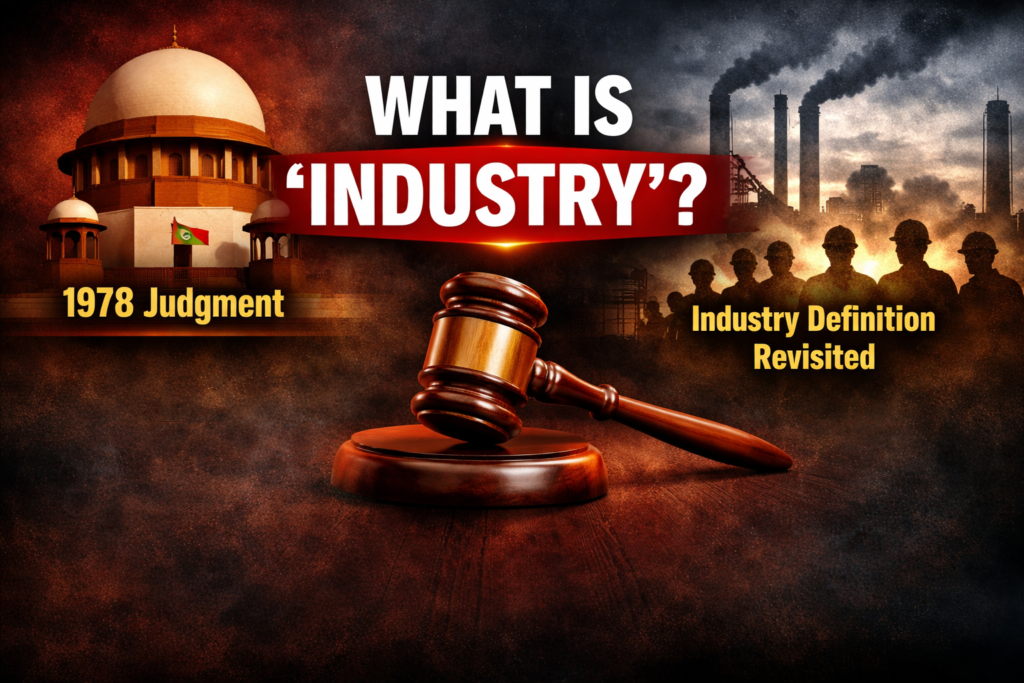
In a move that could reshape labour law across the country, the Supreme Court has decided to take another look at its landmark 1978 Bangalore Water Supply judgment. The core issue sounds simple, but its impact is huge—what should legally be treated as an “industry”? A nine-judge Constitution Bench, headed by the Chief Justice of India, is now stepping in to examine whether that decades-old ruling still fits today’s realities or needs a serious rethink.
“Why This Case Could Change Labour Law Across India”
Back in 1978, the Supreme Court took a bold step and gave the term “industry” a very wide meaning under the Industrial Disputes Act. It said that almost any organised activity involving employers and workers could qualify, even if making profit wasn’t the main goal. Because of this, a wide range of institutions—from hospitals and colleges to charitable organisations—were brought under labour law protections.
But that broad definition hasn’t gone unquestioned. Over the years, critics have argued that it goes too far and blurs the line between real businesses and service-oriented institutions. The result? Ongoing confusion, especially for sectors that don’t function like typical commercial enterprises.
“Not Just a Technicality: Supreme Court Refuses to Drop Key Labour Law Debate”
During the recent hearing, lawyers raised a key procedural point. They argued that since the Industrial Disputes Act has been replaced by the Industrial Relations Code, 2020, there’s no real reason to revisit a decades-old judgment.
But the Supreme Court wasn’t convinced. It pointed out that courts are still relying on the 1978 ruling while deciding ongoing cases. That means the issue is far from outdated. Instead of brushing it aside on a technical ground, the Bench chose to take a deeper look and decide the matter on its actual merits.
“Clash in Courtroom: How Wide Should ‘Industry’ Really Be?”
The hearing turned into a clear face-off, with both sides putting forward strong and very different views.
Senior Advocate Indira Jaising stood firmly behind the 1978 ruling. She argued that cutting down the scope of “industry” could strip many workers of basic legal protection. In her view, excluding certain sectors might leave employees with no real remedy when disputes arise.
On the other side, several lawyers and state representatives called for drawing a clearer line. They argued that not every organised activity should fall under “industry.” Bringing places like temples or purely welfare-driven institutions under labour laws, they said, could create real-world complications.
There was also a bigger concern in play. If the definition stays too broad, it might make running organisations harder and even hold back private investment.
“Beyond Definitions: The Real Legal Puzzle Before the Court”
At the heart of the case lies a deeper legal puzzle—where should the law draw the line? One major point under discussion is the idea of “sovereign functions,” meaning core government duties that may not fit within the scope of industrial laws at all.
The judges also made it clear that you can’t look at the term “industry” in isolation. Its meaning is closely tied to what counts as an “industrial dispute” in the first place. So the Court isn’t just interpreting one word—it’s rethinking how the entire framework of labour law should work together.
“All Eyes on the Final Call: What the Supreme Court’s Decision Could Change”
About the Author