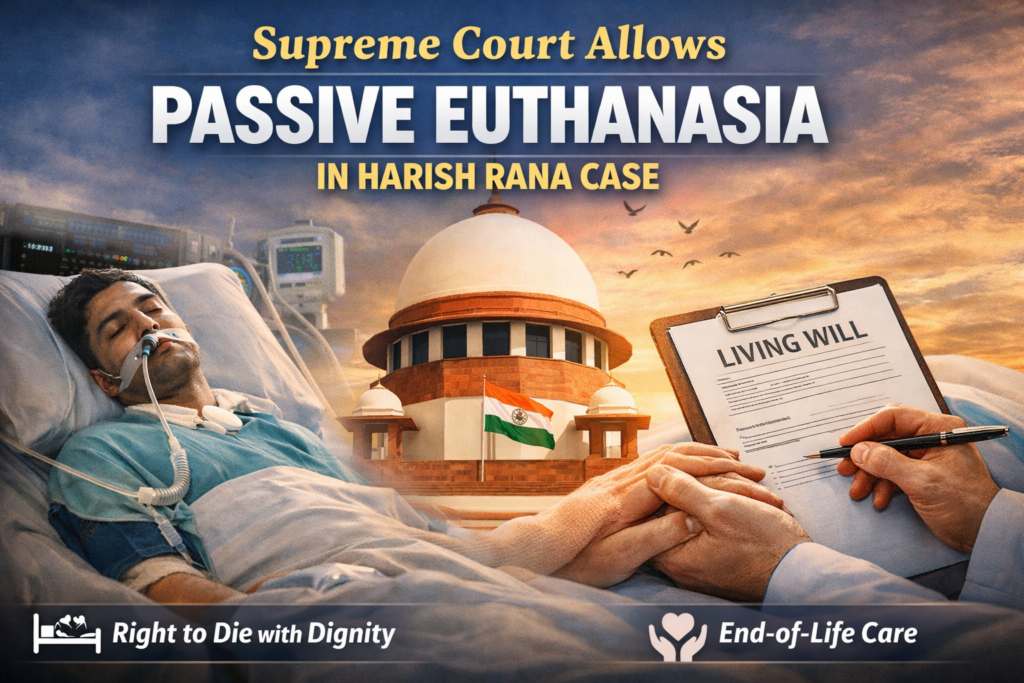
India’s debate on the right to die with dignity took a major turn when the Supreme Court of India allowed passive euthanasia in the Harish Rana v. Union of India & Ors case. The Court permitted doctors to withdraw life-support for a man who had been in a permanent vegetative state for more than 13 years. This decision is significant because it puts into practice the principles laid down in the landmark Common Cause v. Union of India (2018) judgment. In that earlier ruling, the Court recognised that the right to life under Article 21 of the Constitution also includes the right to die with dignity. By applying those principles in a real case, the Court has taken an important step in shaping India’s approach to end-of-life care and patient autonomy.
A Tragic Accident That Led to a Long Legal Battle
The story of Harish Rana began with a tragic accident in 2013. He was only 19 when he fell from the fourth floor of a building in Chandigarh, suffering severe brain injuries. The accident left him in a permanent vegetative state, meaning he lost the ability to respond or perform any voluntary bodily functions.
For nearly 13 years, he stayed alive only because of medically assisted nutrition and hydration through feeding tubes. Doctors continued treatment, but over time they reported that there were no signs of recovery.
With little hope left, his family finally approached the courts and requested permission to withdraw life-sustaining treatment. However, the High Court of Delhi initially rejected their plea. The case then reached the Supreme Court of India, which carefully examined detailed medical reports and the opinions of expert medical boards before giving its final decision.
Supreme Court’s Key Observations on Dignity and End-of-Life Care
In its decision, the Supreme Court of India accepted the opinion of medical experts as well as the wishes of the family. The Court directed that Harish Rana be shifted to a palliative care unit at All India Institute Of Medical Sciences, New Delhi, where doctors would carefully manage the withdrawal of life-support under proper medical supervision.
The judges made it clear that stopping treatment should not be seen as abandoning the patient. Instead, the goal should be to ensure comfort, reduce pain, and provide compassionate care during the final stage of life.
The Court also made an important clarification about clinically assisted nutrition. It stated that feeding through medical tubes is considered a form of medical treatment. If doctors conclude that continuing such treatment will not improve the patient’s condition, it can be withdrawn under the rules of passive euthanasia.
To prevent further delay and prolonged suffering, the Court also removed the usual waiting period and allowed the process to move ahead without the standard 30-day reconsideration gap.
Why Living Wills Matter in End-of-Life Decisions
The case also brought attention to the importance of a living will. A living will allows a person to clearly state their wishes about medical treatment in advance. The idea was recognised by the Supreme Court of India in the landmark Common Cause vs Union of India judgment.
Through a living will, a person can decide whether life-support systems should continue if they are ever unable to make decisions themselves. This becomes important in situations where a patient is unconscious or in a permanent medical condition with no chance of recovery.
Such advance directives protect a patient’s personal choice. They also guide families and doctors during difficult moments, ensuring that medical decisions respect the patient’s own wishes and dignity.
Understanding India’s Law on Euthanasia
Indian law clearly separates two types of euthanasia. Active euthanasia, where a direct action is taken to end a person’s life, is illegal and punishable under criminal law. Passive euthanasia, on the other hand, can be allowed in certain situations when life-sustaining treatment is withdrawn after proper medical review and legal safeguards.
Over the years, the Supreme Court of India has shaped these rules through important judgments. In Aruna Ramchandra Shanbaug v. Union of India, the Court first allowed passive euthanasia under strict conditions. Later, the landmark Common Cause vs Union of India judgment recognised the right to die with dignity. The recent Harish Rana vs Union of India decision builds on these earlier rulings and shows how the legal guidelines can be applied in real-life situations.
Why India Needs Stronger End-of-Life Care
While allowing passive euthanasia, the Court also highlighted a bigger issue: the need for better palliative care in India. Many patients suffering from serious or terminal illnesses still lack access to proper pain relief, emotional support, and counselling.
Experts believe that India should develop a stronger national system for palliative care. This includes better training for healthcare professionals, wider access to medicines for pain management, and more awareness about living wills and end-of-life planning. Improving these services can help patients spend their final days with comfort and dignity.
Conclusion: A Step Toward Dignity in Death
The Harish Rana vs Union of India judgment marks an important moment in India’s ongoing conversation about dignity at the end of life. By permitting passive euthanasia under clear safeguards, the Supreme Court of India has tried to strike a balance between compassion, medical ethics, and constitutional rights.
At the same time, the ruling sends a clear message that legal permission alone is not enough. India also needs a stronger healthcare system that can support patients and their families during the most difficult stage of life. Building such support systems will be key to truly protecting the idea of dying with dignity.
About the Author