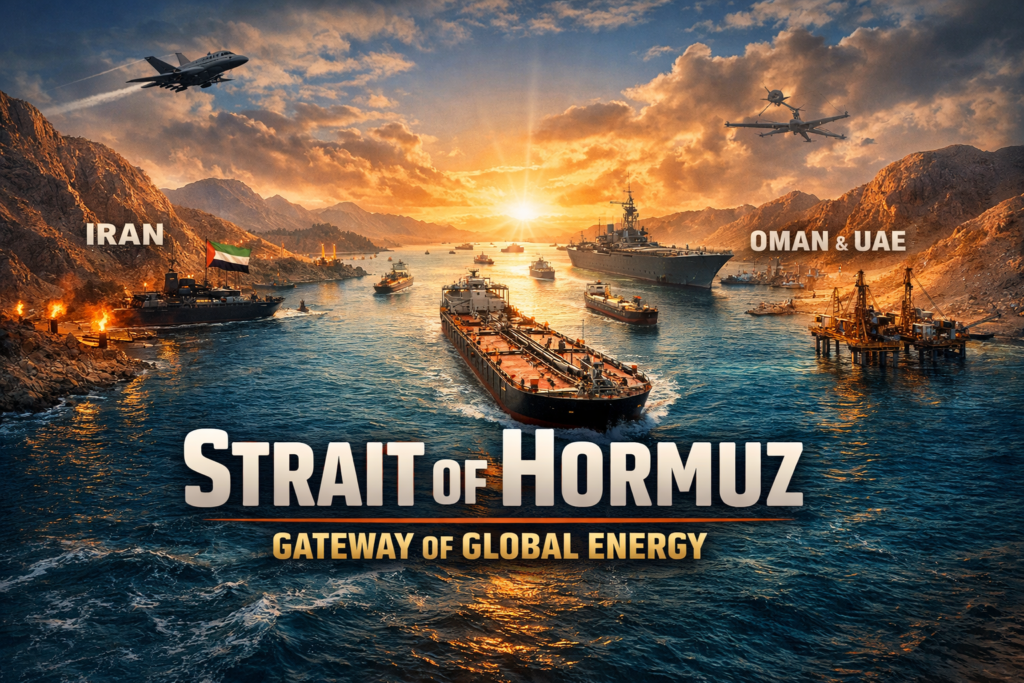
The Strait of Hormuz may look like just another narrow stretch of water on the map, but in reality it is one of the most powerful gateways in the global energy system. This small maritime passage links the Persian Gulf with the Gulf of Oman, eventually opening into the Arabian Sea. Through this single route flows a massive share of the world’s energy supply. Every day, over 20 percent of global oil and liquefied natural gas shipments move through this corridor. Because so much of the world depends on energy transported through this narrow channel, the Strait of Hormuz has become one of the most strategically important and closely watched shipping routes in the global economy.
Geographic Importance
The Strait of Hormuz sits at a crucial meeting point between Iran in the north and Oman and the United Arab Emirates in the south. On the map it may appear like a small strip of water, but its role in the global energy network is enormous. The passage is roughly 35 to 60 miles wide, yet at its tightest point it shrinks to only about 33 kilometers. Because of this position, the strait serves as the main maritime outlet for oil produced in the Persian Gulf, making it the only sea route through which several major energy-producing countries send their exports to the rest of the world.
To manage the heavy movement of ships, the strait operates with two designated shipping lanes. Each lane is about two miles wide, with a similar buffer zone separating them to reduce the risk of accidents. Through these carefully managed routes, massive oil tankers and gas carriers travel in and out of the Persian Gulf every day. Month after month, thousands of vessels move through this narrow channel, carrying vital energy resources to different parts of the globe.
A significant portion of this energy supply is headed toward Asia’s major economies, including China, India, Japan, and South Korea. In fact, nearly 80 percent of the oil and gas transported through the Strait of Hormuz is destined for Asian markets. Because the global energy system depends so heavily on this single passage, even minor tensions or disruptions in the strait can quickly shake international markets and push oil prices upward across the world.
A History of Conflict and Strategic Power
The Strait of Hormuz has never been just a trade route. For decades, it has also been a focal point of political rivalry and military tension in the Middle East. One of the most dramatic moments in its history came during the Iran–Iraq War in the 1980s. During that period, both sides began targeting oil tankers traveling through the Gulf in what later became known as the Tanker War. More than a hundred commercial vessels were attacked, turning a vital shipping route into a dangerous conflict zone. As the situation worsened, international naval forces had to step in to escort ships and protect the flow of global oil supplies.
Even after the war ended, the strait continued to hold enormous strategic importance. Because so much of the world’s energy passes through this narrow waterway, powerful nations closely monitor the region. The United States Fifth Fleet, stationed in Bahrain, plays a major role in maintaining maritime security in the Gulf. Alongside it, naval forces from several other countries regularly patrol the surrounding waters to ensure that commercial vessels can move safely through the passage.
In recent years, rising tensions involving Iran, the United States, and their regional allies have once again drawn global attention to the strait. Incidents such as drone strikes, vessel seizures, and threats to commercial shipping have occasionally created uncertainty for ships traveling through the area. Even brief disruptions or security concerns in this narrow channel can send shockwaves through the global energy market and cause oil prices to react almost immediately.
The Global Energy Lifeline: Economic Power of the Strait of Hormuz
The Strait of Hormuz is not just a narrow sea passage. It is one of the most powerful economic gateways in the global energy system. Every single day, close to 20 million barrels of oil pass through this route, making it one of the busiest and most valuable energy corridors in the world. The scale of trade moving through this channel is enormous, with oil shipments worth hundreds of billions of dollars annually.
What makes this waterway so crucial is the lack of reliable alternatives. Most oil produced in the Persian Gulf must pass through the strait to reach international markets. Because of this dependency, even a small disruption in shipping can quickly create ripple effects across the global economy.
If the flow of tankers through the strait slows down or stops, the global oil supply would immediately shrink. Energy analysts often warn that such a situation could push oil prices sharply upward in a very short time. Rising oil prices do not only affect fuel costs. They also influence transportation expenses, industrial production, and the price of everyday goods around the world.
The impact would be felt most strongly in Asia. Major economies such as China and India rely heavily on energy imports from Gulf producers. For these countries, the Strait of Hormuz acts as a critical energy bridge. Any instability in this route can quickly create economic pressure on industries, governments, and consumers across the region.
Could the Strait of Hormuz Ever Be Blocked?
The Strait of Hormuz is relatively narrow, which often leads to speculation about whether it could be shut down completely. In reality, closing this passage is far more complicated than it might seem. Parts of the strait lie within the territorial waters of Iran and Oman, but international maritime rules allow ships from all nations to pass through this route without obstruction. This principle ensures that the strait remains open for global trade.
Security experts point out that while a full and permanent closure would be extremely difficult, short-term disruptions are possible. Naval confrontations, underwater mines, or missile attacks targeting oil tankers could temporarily slow or interrupt shipping activity. However, maintaining a long-term blockade would be very challenging. The area is heavily monitored by international naval forces, and many powerful countries have a strong interest in keeping this route open because of its critical role in the global energy supply.
Conclusion
The Strait of Hormuz is far more than just a narrow waterway. It is a vital link in the global energy supply chain and a strategic hotspot in international politics. With a large share of the world’s oil exports moving through it, stability in this region is crucial for global economic security. Any disruption in the strait quickly affects energy prices, international trade, and geopolitical relations, making it one of the most closely watched maritime routes in the world.
About the Author