Everything you need to know about E20 petrol’s effect on mileage, engines, and older vehicles — explained by carmakers, IIT Kanpur researchers, and government officials.
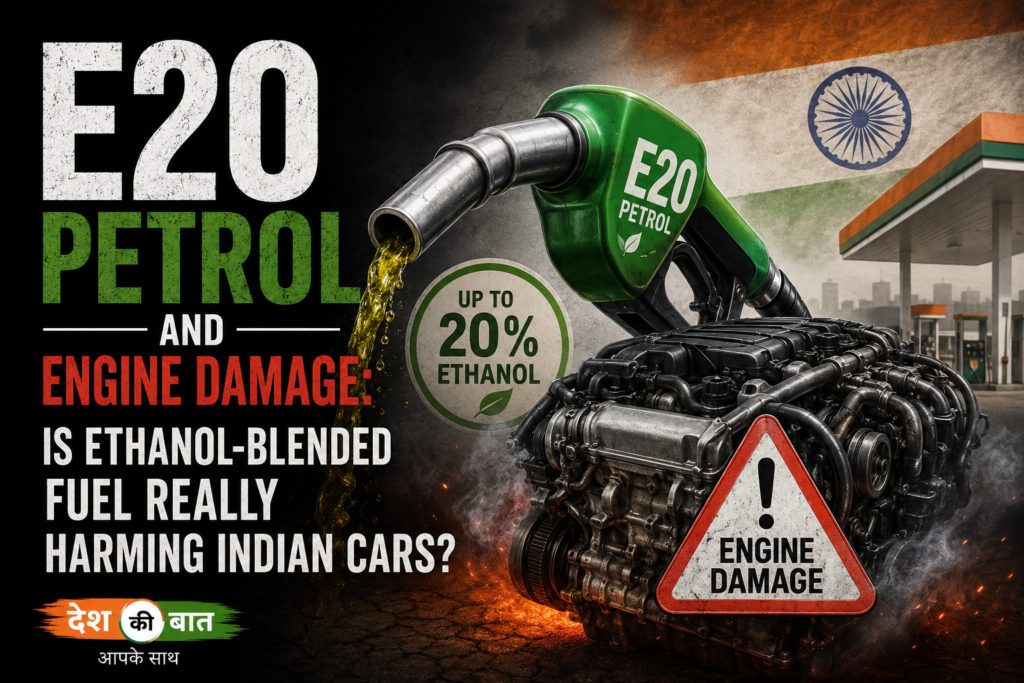
If you’ve filled up at an Indian petrol pump recently, chances are you’ve heard someone complain about E20 petrol — mileage drops, corroded engines, or fuel injectors giving up too soon. The culprit, according to social media chatter, is this ethanol-blended fuel now sold at nearly every pump in the country. But how much of the E20 engine damage outrage is grounded in fact, and how much is panic spreading faster than the fuel itself?
What Is E20 Petrol, and Why Was It Introduced?
E20 is petrol blended with 20% ethanol, up from the earlier E10 standard (10% ethanol). India’s ethanol blending programme has been rolled out nationwide as part of a broader strategy to:
- Cut India’s dependence on crude oil imports
- Reduce vehicular pollution and lower lifecycle carbon emissions
- Create a fuel-linked income stream for farmers growing sugarcane, maize, and other feedstock crops
On paper, it’s a win-win: cleaner air, lower import bills, and better farmer returns. But the rollout hasn’t been friction-free. Owners of older vehicles — many originally designed and certified only for pure petrol or E10 — have raised genuine concerns about whether their engines can handle the higher ethanol content long-term.
Does E20 Petrol Damage Car Engines? What Carmakers Say
Automakers have largely backed the government’s position on E20 fuel safety. Maruti Suzuki, India’s largest carmaker, says it has serviced well over a crore vehicles that weren’t originally E20-certified without finding fuel-related complaints tied to the blend. Toyota and Hero MotoCorp report similar findings, with internal testing showing no meaningful corrosion in metal or plastic components.
Autocar India’s editor, a leading voice in Indian automotive journalism, points out that owner’s manuals simply predate E20 — they were written when E10 was the ceiling, so they naturally don’t reference the newer blend. That doesn’t automatically mean a vehicle can’t handle it. He compares it to how trucks are officially rated for a lower payload than they can structurally bear, purely for liability reasons — manufacturers rarely design a vehicle with zero safety margin.
According to him, genuine ethanol-related engine trouble is overwhelmingly a maintenance issue, not a fuel issue. Ethanol acts like a mild detergent inside the fuel system, which can loosen old deposits and grime in poorly maintained cars, occasionally clogging things up. A regularly serviced, frequently driven car is unlikely to run into trouble.
Why Ethanol-Blended Fuel Can Cause Problems in Idle Cars
There’s also ethanol’s hygroscopic nature — its tendency to absorb moisture from the air. If a car sits unused for over a month, this can lead to phase separation, where the fuel splits and the engine ends up pulling in a non-combustible ethanol-water mix. That can trigger misfires, stalling, or injector damage. This is a storage-and-usage problem, not proof that E20 itself is inherently harmful.
Fuel contamination, another hot-button complaint, isn’t new either. Industry veterans note that similar fears surfaced decades ago during India’s shift from carburettors to fuel injection systems. Quality control at oil marketing companies has improved significantly since then, and localized contamination — not the ethanol blend — is being blamed for isolated breakdown reports.
What Does the Science Say? IIT Kanpur’s E20 Fuel Study
Researchers at IIT Kanpur’s Engine Research Laboratory — which has also successfully trialled E85, an 85%-ethanol blend requiring specially built engines — have weighed in with independent findings. Their extensive testing reportedly found no major evidence of engine damage, corrosion, or systemic technical issues linked to E20 fuel.
Interestingly, the researchers suggest that the often-cited “up to 5% mileage drop” isn’t solely down to the fuel itself; similar variance can show up even across back-to-back tests using pure petrol. Driving style, road conditions, and vehicle maintenance, they argue, affect fuel efficiency more than ethanol content does. The Ministry of Petroleum and Natural Gas has echoed this, acknowledging a possible mileage dip while arguing it’s offset by lower lifecycle carbon emissions and reduced import dependence.
Nitin Gadkari on E20 Mileage Complaints and the “Sponsored Campaign” Claim
Union Transport Minister Nitin Gadkari has been the most vocal defender of the ethanol push, repeatedly dismissing claims of major mileage loss. He has argued that ordinary drivers can’t accurately judge their own car’s mileage without dealer-grade diagnostic tools — a claim that hasn’t landed well with critics, especially since most modern dashboards provide reasonably reliable mileage readouts.
Gadkari has also framed criticism of the ethanol blending programme as a coordinated pushback from interest groups tied to the fossil fuel import business, arguing that his real priorities are cutting India’s fuel import bill, tackling pollution, and building long-term energy self-reliance. He points to global precedent — Brazil has run flex-fuel vehicles capable of handling up to 100% ethanol since the 1970s — and highlights parallel efforts like converting agricultural stubble into bio-CNG, giving farmers in Punjab and Haryana an added income stream while cutting crop-burning pollution.
The Real Concern: Is India’s Ethanol Policy Actually Efficient?
Even setting aside the engine-damage debate, there’s a fair question about who benefits from this policy — and at what cost.
Ethanol production leans heavily on sugarcane, a crop that consumes large amounts of water and fertiliser and is grown mostly in already water-stressed states like Maharashtra and Karnataka. Continuing to produce E20 at a premium over pure petrol, even when crude oil prices fall, effectively means consumers subsidise the system at the pump before farmers see any benefit.
Critics argue that a flat, feedstock-agnostic incentive structure will keep favouring sugarcane simply because it already has the largest processing infrastructure — not because it’s the most water-efficient or food-security-friendly option. Alternatives worth considering include:
- Maize – less water-intensive, though fertiliser-heavy
- Sweet sorghum – shorter growing season, lower water needs than sugarcane
- Second-generation (2G) ethanol – made from crop residue like rice straw, wheat stubble, and groundnut shells, avoiding cropland use altogether and helping curb stubble burning
These alternatives are costlier and more technologically demanding to scale, but that’s arguably a better problem for policymakers to solve than defaulting to the path of least resistance.
E20 Petrol and Engine Damage
Does E20 petrol damage car engines? Based on testing by carmakers like Maruti Suzuki and Toyota, and independent research from IIT Kanpur, there’s no strong evidence that E20 causes engine damage or corrosion in well-maintained vehicles, including many not originally E20-certified.
Does E20 fuel reduce mileage? Some vehicles may see up to a 5% mileage dip, according to the Ministry of Petroleum and Natural Gas, though researchers note similar variance can occur with pure petrol depending on driving habits and road conditions.
Is E20 safe for older cars not certified for it? Most experts say well-maintained, regularly driven older cars can generally handle E20 without major issues. Problems are more likely in poorly maintained vehicles or cars left idle for over a month.
Why does ethanol-blended petrol cause fuel system problems in idle cars? Ethanol is hygroscopic and absorbs moisture from the air. In cars left unused for extended periods, this can cause phase separation, leading to misfires, stalling, or injector issues.
The Bottom Line on E20 Petrol
Strip away the social media noise, and the technical evidence so far doesn’t point to E20 being a ticking time bomb for your engine — provided your car is reasonably well maintained and driven regularly. The bigger, more legitimate debate isn’t really whether E20 damages cars; it’s whether the agricultural and pricing policy behind India’s ethanol blending programme is efficient, equitable, and environmentally sustainable in the long run.
If you’re driving an older vehicle, the practical takeaway is simple: stick to regular servicing, avoid letting your car sit unused for long stretches, and rely on your owner’s manual and manufacturer guidance — not viral posts — before deciding your engine is at risk.
About the Author