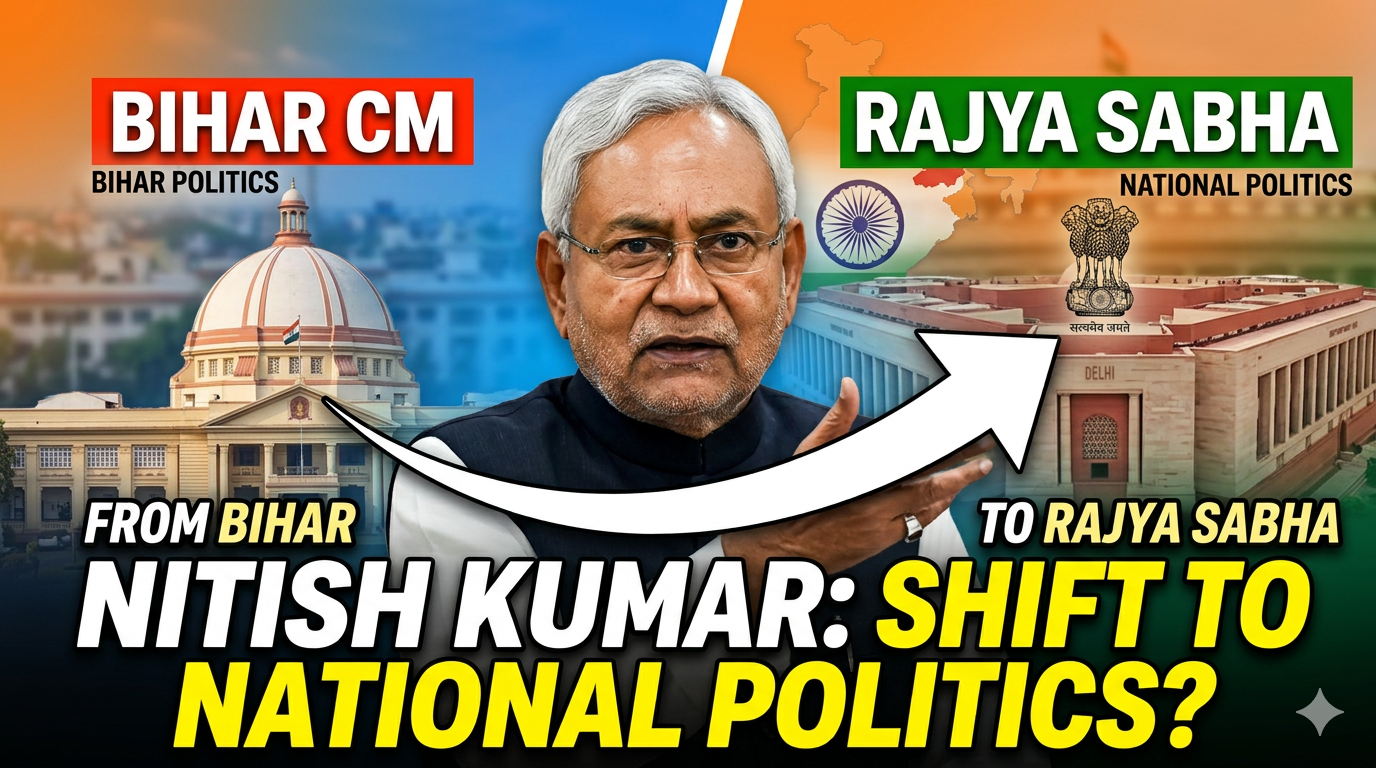
Nitish Kumar Files Nomination for Rajya Sabha: What It Could Mean for Bihar and the National Political Landscape
Introduction
In an important political development, Nitish Kumar has filed his nomination for the Rajya Sabha. The move is being seen as a major moment in his long political journey, which for many years has been closely tied to the politics of Bihar.
For decades, Nitish Kumar has remained one of the most prominent political figures in Bihar. By choosing to enter the Rajya Sabha, he appears to be shifting his focus beyond state politics and moving toward a larger role at the national level.
This decision has naturally triggered fresh debate in political circles. Many are now wondering what it could mean for Bihar’s leadership in the coming years and what political calculations might be behind this step.
Nitish Kumar’s Political Journey
The political journey of Nitish Kumar stretches across more than forty years. He first gained attention during the political movement led by Jayaprakash Narayan in the 1970s, a period that shaped many leaders in Indian politics.
As his career progressed, Kumar went on to hold several important roles at the national level. He served as a Union minister in different central governments and built a reputation as an experienced administrator. However, the most defining phase of his career began in 2005 when he became the Chief Minister of Bihar.
During his time as Chief Minister, Bihar saw several policy initiatives aimed at improving governance and development. Some of the key areas where his government focused include:
- Strengthening road networks and infrastructure
- Improving law and order across the state
- Expanding access to education
- Launching social welfare programs for different sections of society
Over the years, he has led the state through multiple terms in office. Because of this long tenure, he is often counted among the longest-serving chief ministers in India.
Why the Rajya Sabha Move Matters
Nitish Kumar filing his nomination for the Rajya Sabha is not just a routine political step. Many observers see it as a calculated move that could reshape both state and national politics.
1. Entry into National Parliamentary Politics
Although Nitish Kumar has played roles in national politics before, becoming a member of the Rajya Sabha would place him directly inside Parliament again. This would give him a platform to take part in debates, policy discussions, and legislative decisions that affect the entire country.
The Rajya Sabha plays an important role in reviewing laws, maintaining the federal balance between the centre and the states, and shaping long-term national policies.
2. Strategic Role for Janata Dal (United)
Nitish Kumar remains the central figure in the Janata Dal (United). His presence in the Rajya Sabha could strengthen the party’s voice at the national level.
Regional parties often depend on experienced leaders in Parliament to represent their interests, especially during coalition discussions and important legislative debates. Kumar’s experience could help the party maintain its relevance in national political negotiations.
3. Possible Leadership Change in Bihar
This development has also raised an important question about the future leadership of Bihar. If Nitish Kumar gradually shifts his focus toward national politics, it may create space for a new Chief Minister to take charge of the state.
Such a change could lead to a new phase in Bihar’s political landscape and may also signal a generational transition within the party. Moves like this are not unusual in Indian politics, where senior leaders often shift to parliamentary roles after long tenures in state leadership.
Impact on Bihar Politics
The decision of Nitish Kumar to move toward the Rajya Sabha could have a noticeable impact on the political landscape of Bihar. For many years, he has been one of the most dominant figures in the state’s politics, so any shift in his role naturally raises several questions.
Leadership Vacuum
Nitish Kumar has remained at the center of Bihar’s political leadership for almost two decades. If he begins focusing more on national politics, it may lead to discussions within Janata Dal (United) about who could take over the leadership role in the state. Choosing a successor would be an important decision for the party as it prepares for future elections and governance responsibilities.
Opposition Strategy
A leadership change could also create an opportunity for opposition parties to strengthen their position. Political groups such as Rashtriya Janata Dal and Indian National Congress may try to use this moment to sharpen their political strategy and expand their support base in the state.
Governance Continuity
Another important question is whether the governance approach introduced during Nitish Kumar’s tenure will continue in the same way. Over the years, his policies on infrastructure development, social justice, and administrative reforms have played a major role in shaping Bihar’s development narrative. The future leadership will likely face the challenge of maintaining continuity while also introducing its own priorities.
National Political Implications
The entry of Nitish Kumar into the Rajya Sabha could also have wider effects on national politics. Given his long experience in governance and coalition politics, his role in Parliament may influence political discussions beyond Bihar.
Coalition Politics
Indian politics today often depends on alliances and cooperation between multiple parties. In such a system, leaders who understand coalition management become especially important.
Nitish Kumar has built a reputation over the years as someone who can work with different political groups and maintain working relationships across party lines. Because of this, his presence in Parliament could become important during alliance negotiations and political coordination.
Legislative Role
The Rajya Sabha often benefits from the presence of experienced administrators and senior political leaders. These members usually contribute to detailed debates on governance, centre–state relations, and development policies.
With decades of administrative and political experience, Nitish Kumar could bring a seasoned perspective to parliamentary discussions and legislative decision-making.
A New Phase in Nitish Kumar’s Career
The nomination of Nitish Kumar to the Rajya Sabha appears to mark the start of a new chapter in his political journey.
For most of his career, his work and influence have been closely connected to the politics and governance of Bihar. Now, this move suggests that he may gradually shift his attention toward national political debates and parliamentary responsibilities.
If this transition continues, Kumar could play a larger role in shaping policy discussions at the national level while also strengthening the presence of Janata Dal (United) in Parliament. Political observers will be watching closely to see how this shift develops in the months ahead.
Conclusion
The decision of Nitish Kumar to file his nomination for the Rajya Sabha marks an important moment in the current political landscape. It not only reflects a possible turning point in his long political career but may also signal changes in the leadership structure of Bihar.
Whether this step eventually leads to major shifts in Bihar’s politics or helps expand the national influence of Janata Dal (United) will become clearer in the coming months.
What remains certain is that Nitish Kumar’s move to the Rajya Sabha adds another significant chapter to a political journey that has already played a major role in shaping Bihar’s governance and influencing national political discussions.
About the Author





I liked how clearly you explained the political situation. According to you, will this move make JD(U) stronger at the national level or is it just a way to maintain political relevance?
I don’t think this move will make Janata Dal (United) stronger at the national level. If anything, it risks weakening the party’s core identity.
For years, JD(U) has been closely tied to Nitish Kumar. His image as a governance-focused, moderate leader is what gave the party its distinct space in Indian politics. But if he steps back as Chief Minister, that creates a leadership vacuum the party may struggle to fill. JD(U) has never really built a strong second line of leadership, so its influence could shrink without him at the front.