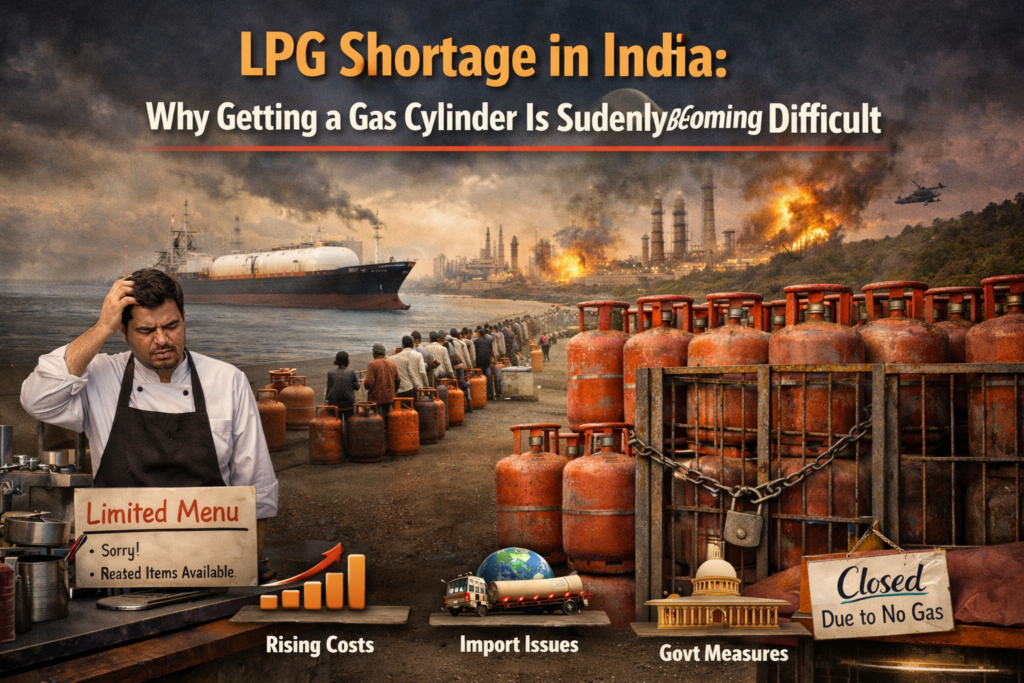
LPG Shortage in India: Why Getting a Gas Cylinder Is Suddenly Becoming Difficult
In many cities across India, getting an LPG cylinder isn’t as easy as it used to be. Restaurants are cutting down their menus, hotels are struggling to keep their kitchens running, and some small food stalls have even closed for a few days because they can’t get enough gas.
Households are still receiving cylinders in most places, but commercial users like restaurants and caterers are facing real shortages. This situation has once again highlighted how much India depends on imported LPG and how quickly global problems can start affecting daily life here.
To understand what’s really going on, it’s important to look at the data, the international factors behind the shortage, and the steps the government is taking to manage the situation.
India Uses Much More LPG Than It Produces — Why Imports Have Become So Important
One major reason behind the current LPG supply pressure is simple: India consumes far more LPG than it produces at home. Because of this gap, the country has to depend heavily on imports to meet everyday demand.
According to data from the Petroleum Planning and Analysis Cell for the first half of FY 2025–26, India produced about 6,219 TMT of LPG, while total consumption reached around 16,200 TMT. To bridge this large gap, the country imported nearly 10,731 TMT, which means about 62% of India’s LPG supply comes from foreign sources.
| Metric | Value |
|---|---|
| LPG Production | 6,219 TMT |
| LPG Consumption | 16,200 TMT |
| LPG Imports | 10,731 TMT |
| Import Dependency | 62% |
LPG demand in India has grown quickly over the last decade. Millions of households have shifted to LPG for cooking as government schemes expanded access and living standards improved. While this shift has made cooking cleaner and safer, domestic production hasn’t grown at the same speed. As a result, India now relies heavily on imports to keep kitchens running across the country.
Most of India’s LPG Is Used in Household Kitchens
A big part of India’s LPG demand comes from households. In fact, around 90% of LPG cylinders in the country are used for cooking in homes. For millions of families, LPG is the main fuel for preparing daily meals.
Because cooking gas is such an essential household need, the government usually gives priority to domestic consumers when supply becomes tight. The goal is to make sure families can still cook their meals even during shortages.
That’s why, in the current situation, most households are still able to get their gas cylinders. The pressure is being felt more by Commercial users like restaurants, hotels, and small food stalls, who often face shortages first when supply becomes limited.
How Tensions in West Asia Are Disrupting LPG Supply to India
The current LPG shortage in India is not just a local problem. It is also connected to rising tensions in West Asia, a region that supplies a large share of the world’s energy.
Recent tensions involving the United States, Iran, and Iraq have created uncertainty around energy supply routes. One of the biggest concerns is the Strait of Hormuz, a narrow but extremely important sea route through which a large portion of the world’s oil and gas shipments pass every day.
As tensions rise in the region, tanker movements have slowed and some shipments have been delayed. Since India imports a large share of its LPG from the Middle East, any disruption in this route quickly affects supply in the country.
Reports indicate that nearly 60 million standard cubic metres of gas mmscmd supply per day from the region has been affected. When flows slow down at this scale, it puts pressure on global energy markets and eventually impacts LPG availability in countries like India.
LPG Shortage Hits Restaurants, Hotels, and Small Food Businesses the Hardest
The ongoing LPG shortage is hitting the hospitality and food industry the hardest. Restaurants, hotels, street vendors, and catering services depend heavily on commercial LPG cylinders to run their kitchens. In several cities such as Bengaluru, Mumbai, Chennai, and Goa, many eateries are struggling to keep their kitchens running because commercial gas cylinders are becoming difficult to find.
To cope with the shortage, some restaurants have reduced their menus, taken temporary holidays, or switched to alternatives like induction cooktops and microwaves. Small food vendors and street stalls are feeling even more pressure because they operate with very small profit margins. Even railway catering services are preparing for disruptions by keeping ready-to-eat food and using electric cooking options. If the shortage continues, industry groups warn that a large number of restaurant outlets could temporarily shut down, which may also affect tourism and local businesses.
What the Government Is Doing to Keep LPG Supply Stable
To control the LPG shortage and prevent panic, the government has taken several quick steps to stabilize supply. LPG and CNG have been placed under the Essential Commodities Act priority list so that their availability can be closely monitored and protected during disruptions.
At the same time, authorities have asked oil refineries to increase domestic LPG production by around 10% and divert more propane and butane for LPG manufacturing. The main focus right now is to ensure that household cooking gas supply remains uninterrupted, since millions of families depend on it every day.
Officials have also advised people not to panic book cylinders, assuring that domestic LPG supply is still stable and the situation is being closely managed.
India’s LPG Shortage: Why This Crisis Matters for the Economy, Businesses, and Energy Security
The current LPG shortage is not just a temporary problem with gas cylinders. It shows a bigger challenge for India’s energy system. Since a large share of LPG is imported, any disruption in global supply routes—especially through the Strait of Hormuz—can quickly affect availability in the country. When supplies slow down, businesses like restaurants, hotels, and small food vendors face rising costs and operational problems. The situation is also being closely watched in the stock market, particularly for major oil companies such as Indian Oil Corporation, Bharat Petroleum, and Hindustan Petroleum. If disruptions continue, it could lead to higher fuel costs and wider economic impact. This crisis is a clear reminder that global energy tensions can directly affect daily life in India and highlights the urgent need to strengthen domestic production and reduce dependence on imports for long-term energy security.
About the Author