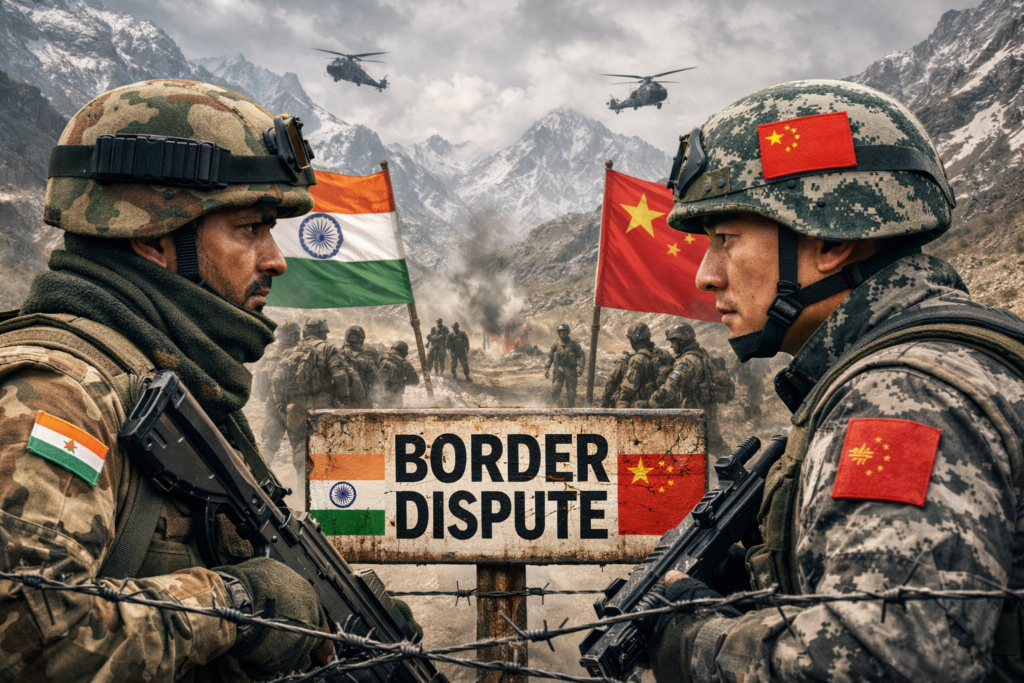
The India–China border dispute isn’t just today’s headline—it’s a story shaped by history. What began as unclear lines drawn during the colonial era has slowly turned into a long-standing conflict, driven by competing claims and deep mistrust.
Where It All Began: Borders Drawn Without Consent
The roots of the India–China border issue go back to the 19th century, when British officials tried to map out the Himalayas—often from a distance and with limited knowledge of the terrain. These weren’t carefully negotiated borders. They were rough lines sketched on maps, without any real agreement from China.
Take Aksai Chin as an example. One British proposal, known as the Johnson Line, placed the entire region within India. Later, another version—the Macartney–MacDonald Line—suggested the opposite, handing it over to China. The real problem wasn’t just the difference between these lines—it was that none of them were ever officially accepted by both sides or properly marked on the ground.
So when India became independent in 1947, it inherited borders that looked clear on paper but were anything but settled in reality. That early confusion didn’t fade away—it quietly set the stage for the tensions we see today.
Three Fronts, One Dispute: Where India and China Still Clash
1. Western Sector (Ladakh – Aksai Chin): The Most Volatile Zone
This is where tensions run the highest. India sees Aksai Chin as part of Ladakh, but China controls the region and treats it as part of Xinjiang. The disagreement goes back to old British-era maps that never clearly settled the boundary. Today, this area remains a major hotspot, especially along the Line of Actual Control (LAC), where face-offs between troops are not uncommon.
2. Middle Sector (Himachal Pradesh–Uttarakhand): Quiet but Unsettled
Compared to other sectors, this region is relatively calm—but not completely free of disputes. Places like Bara Hoti and the Nelang Valley have seen occasional patrol-level tensions. These may not grab headlines often, but they show how even small differences in border perception can create friction.
3. Eastern Sector (Arunachal Pradesh): The Deepest Disagreement
This is where the positions are sharply divided. China claims the whole of Arunachal Pradesh, while India firmly considers it an integral part of the country. The dispute traces back to the McMahon Line, drawn during the 1914 Shimla Convention between British India and Tibet. While Tibet accepted this boundary, China did not, and that disagreement still shapes tensions in the region today.
From Friendship to Friction: Tibet and the Shift in India–China Ties
In the early years after independence, India and China appeared to be on good terms, captured in the popular slogan “Hindi-Chini Bhai Bhai.” But that phase didn’t last long. The real turning point came in 1959, when unrest broke out in Tibet.
As the situation escalated, the Dalai Lama fled to India and was granted asylum. This move didn’t sit well with China, which began to view India with growing suspicion. The trust that once defined their relationship quickly started to fade.
Not long after, both countries began increasing their military presence along the disputed border. Patrols became more aggressive, face-offs more frequent, and accusations of border violations started flying from both sides. What was once a friendly relationship had now begun to shift toward open tension.
1962: The War That Changed Everything
Rising tensions finally boiled over into open conflict in 1962. Fighting broke out across two main fronts—Ladakh in the west and Arunachal Pradesh in the east—turning a long-simmering dispute into a full-scale war.
China launched a coordinated offensive and gained the upper hand within a short span of time. The conflict was brief but intense. By November 1962, China announced a ceasefire, pulled back from the eastern sector, but continued to hold control over Aksai Chin in the west.
The impact of this war ran deep. It shattered any remaining trust and left a lasting mark on India–China relations, shaping how both countries approach the border issue even today.
Today’s Reality: An Unfinished Border, Ongoing Tensions
Even now, the India–China boundary isn’t fully settled on the ground. Instead of a clearly agreed border, both sides follow the Line of Actual Control (LAC), which works more like a practical divide than a formally accepted boundary—and each country has its own understanding of where it runs.
Recent standoffs in places like Ladakh, Doklam, and parts of Arunachal Pradesh make it clear that the issue is still very much alive. Talks and negotiations do happen, but the core problem hasn’t changed: old, unclear boundaries and competing claims continue to keep tensions simmering along the border.
Beyond Borders: Why This Dispute Still Matters
The India–China border issue goes far beyond a fight over territory. It’s shaped by history, driven by politics, and influenced by how each side views the past. Boundaries drawn during the colonial period—often without clarity or mutual consent—left behind a legacy that still affects relations today.
Unless both countries manage to bridge these historical differences and agree on a clear boundary, tensions are likely to remain. For now, this continues to be one of the most sensitive and closely watched borders in the world.
About the Author