The debate over the three-year practice requirement for entry into the judiciary has once again reached the of Supreme Court of India. During a recent hearing, the Court clarified that the rule requiring advocates to complete three years of legal practice before applying for the post of Civil Judge (Junior Division) will continue for the time being. At the same time, the Court observed that the main concern is not the rule itself, but the way it should be properly implemented.
In a move that offers relief to many judicial service aspirants, the Court also directed all High Courts across the country to extend the last date for submitting applications for Civil Judge posts until April 30, 2026. This decision ensures that candidates do not face any disadvantage while the issue is still being examined by the Court.
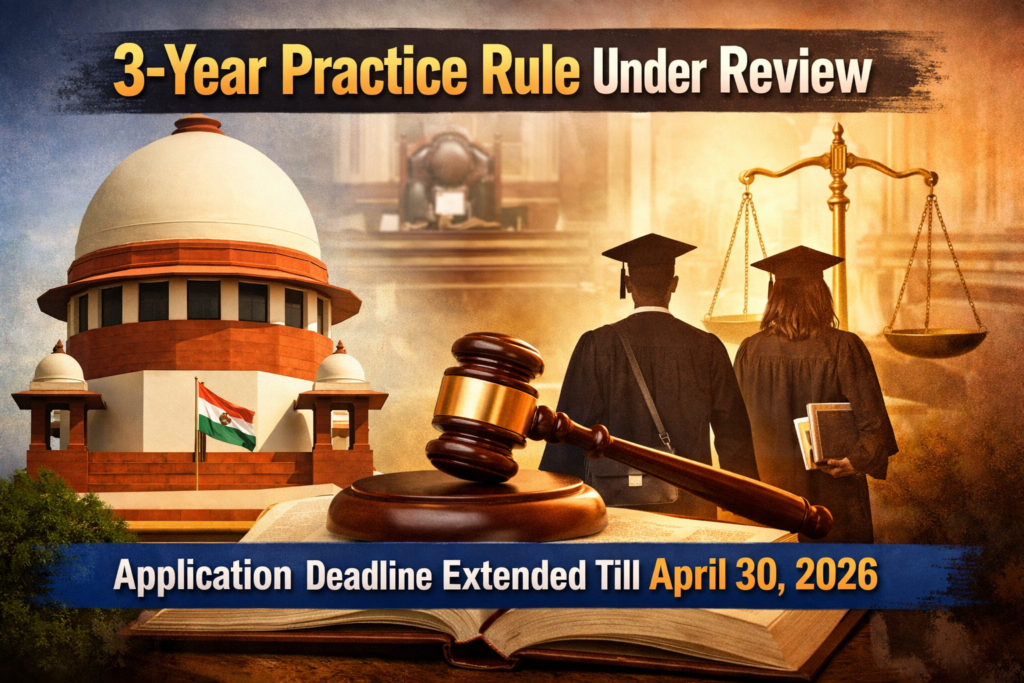
Supreme Court Directs High Courts to Extend Application Deadline
A bench led by the Chief Justice noted that several states had already started their Civil Judge recruitment process. To maintain fairness and avoid confusion among candidates, the Supreme Court directed all High Courts to extend the last date for submitting applications.
According to the Court’s direction, states where recruitment notifications have already been issued must now extend the application deadline until April 30, 2026. The Court also clarified that any new recruitment advertisements released by High Courts or State Public Service Commissions should follow the same deadline.
This step brings major relief for many judicial service aspirants who were uncertain about their eligibility due to the ongoing legal debate over the three-year practice requirement.
Court Highlights the Value of Real Courtroom Experience
During the hearing, the Chief Justice noted that the three-year practice requirement is not a new idea. It comes from an earlier judgment of the Supreme Court, and therefore it carries legal weight and must be respected.
The Court explained that the rule exists for a clear reason. Future judges should have real courtroom exposure before they take up judicial duties. Working as an advocate helps them understand how courts function, how cases are argued, and what challenges lawyers and litigants face during proceedings.
The bench also observed that having only a law degree may not always be enough preparation for someone who will soon be deciding cases and delivering judgments. Practical legal work plays an important role in building that understanding.
At the same time, the Court raised an important concern about how this rule should be applied. It pointed out that simply being present in court without actively learning, assisting in cases, or engaging in legal work cannot automatically be treated as meaningful legal practice.
Debate Grows Within the Legal Community
The three-year practice rule has started a wide discussion across the legal community. Many High Courts support the requirement, saying that experience at the Bar helps future judges understand the realities of litigation and makes them better prepared for judicial work.
On the other hand, several law universities and legal scholars have raised concerns about this condition. They believe that the rule may slow down the entry of talented law graduates into the judiciary, even if they are academically strong and ready to take up the role.
Some critics have also pointed to the financial struggles young lawyers often face in the early years of practice. For many fresh graduates, especially those without family support in the legal profession, surviving the initial years can be challenging. Because of this, the rule may unintentionally create difficulties for candidates from economically weaker backgrounds who wish to join the judiciary.
Suggestions for Reform
Amid the ongoing debate, some legal institutions have suggested alternative ways to prepare future judges. Instead of making three years of practice compulsory before appearing for the exam, they propose stronger and more structured training after candidates are selected.
Under this idea, candidates would first clear the judicial service examination and then undergo detailed training at judicial academies. This training could include supervised courtroom exposure, judgment writing practice, and practical lessons on handling cases and court procedures.
Supporters of this model believe it could create a more structured and uniform system for preparing judges, while also allowing talented law graduates to enter the judiciary earlier.
The Road Ahead
The Supreme Court is likely to continue hearing the review petitions in the coming days. While the Court has indicated that the three-year practice requirement may remain, it may still look at ways to improve the system and address the concerns raised by different stakeholders.
The final decision will be important for thousands of law graduates who hope to join the judiciary. For now, the extension of the application deadline gives candidates more time while the legal position becomes clearer.
The larger debate around the three-year practice rule reflects an important goal—improving the quality of the judiciary while also ensuring fair and equal opportunities for aspiring judges.
About the Author